Cold Process
Gel Phase in Cold Process Soap: What It Is and How to Control It
Learn what gel phase is in cold process soap, how it affects your finished bar, and how to force or prevent it depending on your goals.
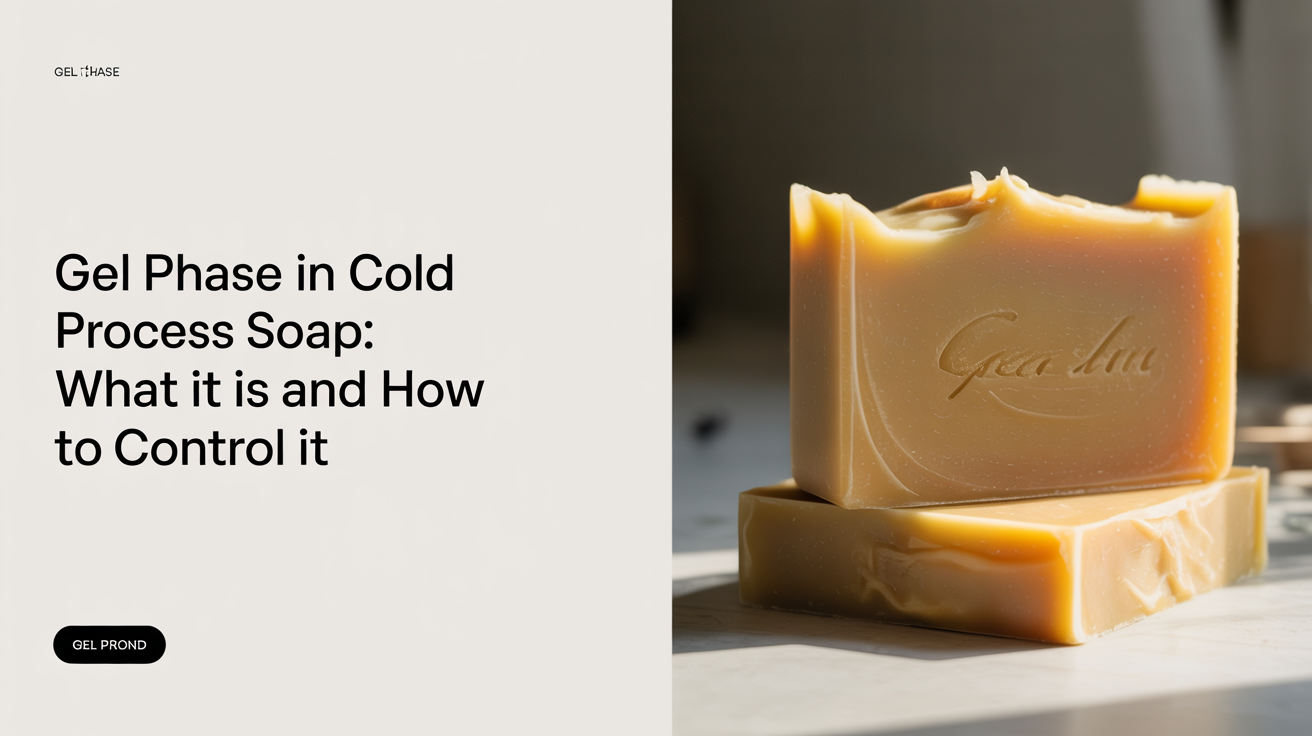
When you pull a cold process batch out of the mold and it looks translucent in the center but chalky white toward the edges, you are looking at the result of inconsistent gel phase. It is one of those things that catches beginners off guard the first time, mostly because no one warned them the soap would glow like a lava lamp for a few hours. Understanding what gel phase actually is, and knowing whether you want it or not before you pour, saves a lot of confusion later.
Gel phase is not a defect. It is a normal stage of saponification, and whether your soap goes through it fully, partially, or not at all is something you can control with a few straightforward choices. Before you work with any cold process soap, make sure you are wearing goggles and heat-resistant gloves, working in a ventilated space, and have run your recipe through a lye calculator. Always add lye to water, never the other way around. With that covered, here is everything you need to know about gel phase.
What Gel Phase Actually Is
During saponification, the lye and oils react and generate heat. In a well-insulated mold, that heat builds until the soap reaches roughly 140 to 160 degrees Fahrenheit (60 to 71 degrees Celsius). At that temperature, the soap mass becomes semi-translucent and develops a slick, gel-like texture. This is gel phase. As the soap cools back down, it returns to an opaque state, but the bar that results is slightly different from one that never gelled.
The key change that happens during gel phase is at the microscopic level: the saponified oils reorganize into a more ordered crystal structure. This is why gelled soap often looks a bit darker, more vibrant in color, and slightly more translucent even after it has fully cured. The soap is chemically the same as un-gelled soap, it has just gone through a different thermal history on its way there.
Gel phase is not required for a finished bar to be safe or effective. Both gelled and un-gelled soaps, given enough cure time (usually four to six weeks for a standard cold process recipe), will perform similarly in the shower. The difference is mostly visual.
What Gel Phase Does to Your Finished Bar
The clearest effect of full gel phase is appearance. Gelled soap tends to look slightly more jewel-toned, with colors that read a bit richer and a surface that has a slight sheen. This is especially noticeable with natural colorants like spirulina, paprika, or activated charcoal, which tend to look more vivid in a soap that has gelled fully.
Un-gelled soap (also called "no-gel" soap) looks matte and chalky when it comes out of the mold, and it usually stays that way. The colors are softer and more pastel-adjacent, which some makers actually prefer, especially for soaps with a delicate, powdery aesthetic.
There are a few practical effects beyond looks:
- Cure time: Some soapers find that gelled bars feel harder sooner, though the difference is not dramatic. Either way, a full four-to-six-week cure is still the standard.
- Superfat distribution: This is a minor consideration, but saponification during gel phase is slightly more complete, so un-gelled soaps may retain a touch more unsaponified oil on the surface. In practice, this rarely matters if your recipe is balanced.
- Fragrance retention: Some fragrances, particularly florals, fade faster at higher temperatures. If you are using a delicate fragrance or essential oil, skipping gel phase may help preserve the scent.
How to Force Full Gel Phase
If you want the richer look and slightly faster hardening of a fully gelled bar, you can encourage gel phase by insulating the mold after pouring. The idea is to trap the heat the saponification reaction generates so the soap gets hot enough to gel all the way through.
Here is a basic approach:
- Pour your traced soap into the mold as normal. For a refresher on what trace looks like and how to reach it, see what is trace in soap making and how to reach it.
- Place a piece of cardboard or a cutting board on top of the mold to act as a lid.
- Wrap the whole mold in one or two bath towels.
- Set it somewhere it will not be disturbed for 24 hours.
- After 24 hours, unwrap, check for any issues (ash, soda ash, soft spots), and let it rest another 12 to 24 hours before unmolding.
A more reliable method is the oven process gel (OTPG). You preheat your oven to 170 degrees Fahrenheit (77 degrees Celsius), turn it off, and then place the freshly poured mold inside. The residual warmth is enough to carry the soap through gel phase without overheating it. This is useful for soaps with colorants or fragrances that benefit from a more controlled environment.
Silicone molds gel faster than wood molds because silicone does not absorb heat. Recipes high in soft oils (sunflower, canola, rice bran) also tend to gel more readily than hard-oil-heavy recipes.
How to Prevent Gel Phase
Sometimes you want the soft, matte look of un-gelled soap, or you are using milk, honey, or other heat-sensitive additives that can scorch or turn orange if the soap gets too hot. In those cases, you want to stop gel phase from happening.
The most effective tool is the refrigerator or freezer. Once you have poured your soap, place the mold in the refrigerator (not the freezer, unless you are making milk soaps and want to move very quickly) for the first 24 hours. The cold environment draws heat away before the soap can reach gel temperature.
A few other approaches:
- Work with cooler temperatures. If your oils and lye solution are both around 90 to 100 degrees Fahrenheit (32 to 38 degrees Celsius) when you combine them, the starting temperature is lower and there is less heat to build on. Most cold process recipes are forgiving in this range.
- Use a water discount. More water in a recipe means more thermal mass that needs to heat up. A water discount (using less water than a standard recipe calls for) can actually make gel phase more likely, not less. If you want to avoid gel, lean toward a standard water amount.
- Avoid insulating. Simply leave the mold uncovered in a cool room. Without insulation trapping heat, many batches will not reach gel temperature.
The Problem with Partial Gel Phase
Partial gel is the situation you actually want to avoid. This happens when the center of the mold gets hot enough to gel but the edges do not. The result is a soap with a darker, slightly translucent ring in the center surrounded by a chalky, lighter outer layer. The soap is still perfectly usable, but it looks like a target, and that appearance is difficult to hide.
Partial gel usually happens when a maker half-insulates a mold or places it in a location where one side is warmer than the other. The fix is to go all the way in one direction: either insulate fully to encourage complete gel, or refrigerate to prevent gel entirely. Partial measures tend to produce partial results.
If you have a batch with partial gel and want to check that it is safe to use, do a zap test once it has cured. Touch a corner of the bar to the tip of your tongue. If you feel a zap or tingle, active lye is still present and the bar needs more cure time. No zap means saponification is complete and the bar is safe.
Frequently Asked Questions
Does gel phase change how the soap lathers or performs? Not in any way most people would notice. Both gelled and un-gelled soap, properly cured with a balanced recipe, lather and cleanse comparably. The difference is cosmetic.
Why did my soap get really hot and look almost see-through right after I poured it? That is exactly what gel phase looks like in progress. The heat from saponification is building, and the soap is moving through the translucent gel stage. As long as you do not see separation, cracks, or a volcano-like overflow (which would indicate a lye-heavy recipe or a false trace situation), this is normal. Let it sit and it will opaque back up as it cools.
Can gel phase cause lye pockets or make my soap unsafe? No. Gel phase does not affect the chemistry of saponification or create any new safety hazards. The reaction between lye and oils is what determines whether soap is safe; gel phase is just a thermal effect of that reaction. The standard cautions still apply: always wear goggles and gloves when making soap, and always run your recipe through a lye calculator before you start.
My milk soap turned orange after insulating. What happened? Milk sugars scorch at high temperatures, which causes a yellowish-orange discoloration called "dreaded orange spots" or just heat discoloration. This is a known risk with any sugar-containing additive (milk, honey, oatmeal water). For milk soaps, skip the insulation and go straight into the refrigerator after pouring to keep temperatures down.
I am a beginner. Should I try to force gel phase or avoid it on my first batch? Neither approach is difficult, but if you want a more forgiving first experience, skip the insulation and let the soap find its own temperature in a cool room. You may get partial gel or no gel at all, but both produce usable bars. Once you are comfortable with the basic cold process steps, you can experiment with forcing or preventing gel phase to get the exact look you want.