Cold Process
What Is Trace in Soap Making (and How to Reach It)?
Trace is the moment your soap batter emulsifies and thickens enough to leave a mark on its surface. Learn the stages and how to reach each one safely.
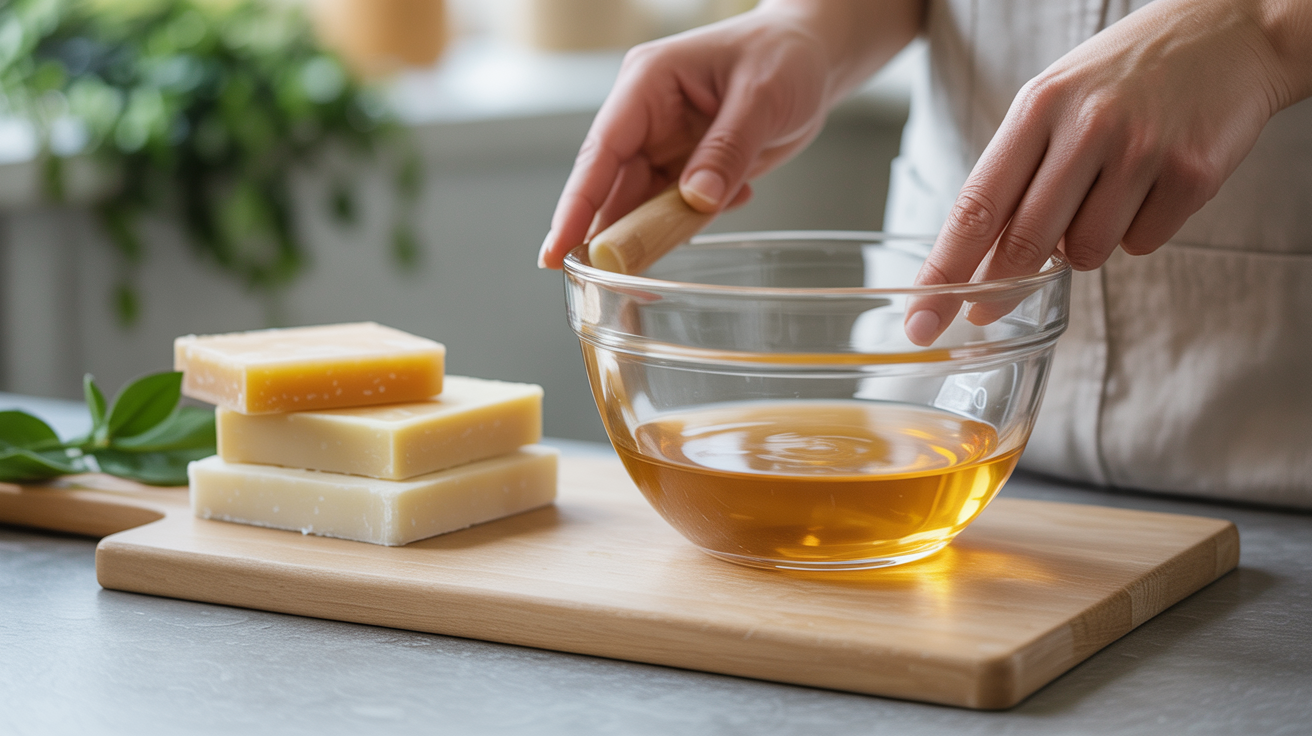
Trace is the point at which your lye solution and oils have fully emulsified and the batter has thickened enough that a drizzle on the surface leaves a visible trail before sinking back in. Think of it like melted chocolate that's begun to set: still fluid, but with body. Reaching trace means saponification has started and your soap batter is ready to receive color, fragrance, and eventually the mold.
New soapers sometimes confuse trace with complete saponification. It isn't. Trace is an early milestone in the process. The full chemical reaction between lye and oils continues for hours after you've poured the mold, and the soap keeps curing for weeks after that. But trace is the signal you've been waiting for before you pour.
At a Glance
- Trace is visible thickening, not finished chemistry; saponification keeps running for roughly 24-72 hours after you pour, and the bar isn't safe or mild until it has fully cured.
- Light trace (thin pudding) is the sweet spot for adding fragrance and colorant; thick trace (mashed-potato consistency) is your last chance to pour before the batter seizes in the pot.
- A stick blender turns a 30-45 minute hand-stir into a 2-5 minute job, which is convenient but makes it easy to overshoot the stage you actually wanted.
- Fast-tracing oils (coconut, palm kernel) and fast-tracing fragrances (spice, floral, vanilla-heavy blends) are the two most common reasons a batch reaches thick trace before you're ready.
- Lye itself stays caustic and dangerous until the reaction is complete, so protective gear applies at the mixing stage regardless of how quickly or slowly your particular batter traces.
- If the batter rices or seizes, blending on low often smooths it back out; if it stays lumpy, pour anyway, a lumpy bar is still a usable bar.
What's Actually Happening at Trace
When you combine your lye solution with your oils, you're triggering saponification, the chemical reaction that turns fats and sodium hydroxide into soap and glycerin. Before the oils and lye have properly combined, the mixture looks oily and separated, like a broken salad dressing. Stirring or blending drives the two phases together until an emulsion forms.
Emulsification happens before trace is visible. At first the batter looks uniform but still thin, almost like skim milk. As you continue blending, the emulsion thickens into a pourable custard, then thicker still. "Trace" refers to the visible thickening that tells you the emulsion is stable enough to work with.
The stick blender accelerates this enormously. A recipe that might take 30-45 minutes of hand stirring to reach trace can get there in 2-5 minutes with a stick blender. That speed is useful, but it also means you can overshoot your target stage before you've had time to add fragrance or do any design work.
Why Trace Speed Isn't the Same for Every Oil
Different fats saponify at different rates, and the difference comes down to fatty acid chain length. Coconut and palm kernel oil are unusually rich in lauric acid, a short-chain fatty acid that saponifies quickly and is exactly the compound most commercial "coconut soap" and sodium laurate are built from. A recipe heavy in either oil reacts faster and traces sooner than a recipe built mostly on longer-chain oleic acid oils like olive or sunflower. This is chemistry, not inconsistency between batches; if your recipe's oil blend hasn't changed, trace speed shouldn't swing wildly from one attempt to the next unless temperature or fragrance is the variable.
The Stages of Trace
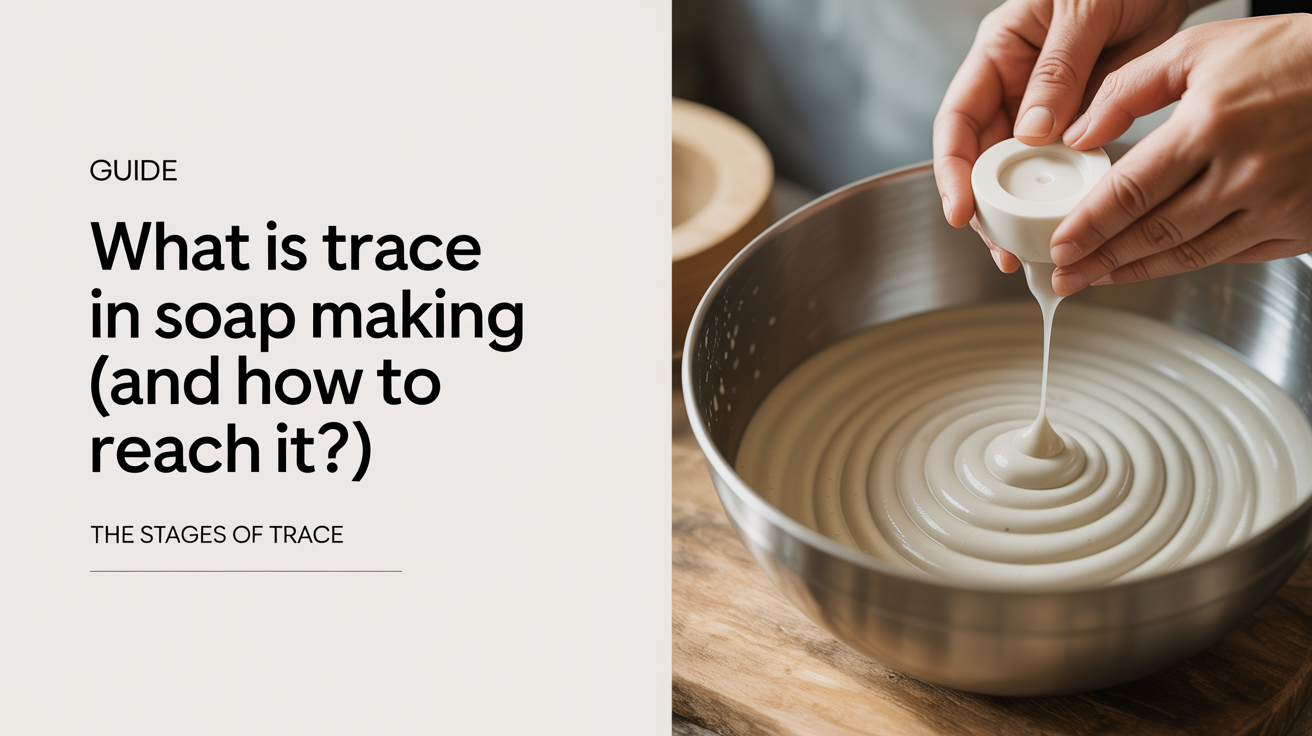
Not all trace is the same. The batter passes through several distinct stages as it thickens, and the right stage for each task varies.
| Stage | What It Looks Like | What to Do |
|---|---|---|
| Emulsion (pre-trace) | Uniform but thin, like whole milk | Keep blending; don't add fragrance yet |
| Light trace | Thin pudding or melted ice cream; drizzle holds briefly | Add fragrance, colorants, and any additives |
| Medium trace | Thicker pudding; drizzle sits on surface for several seconds | Pour into mold; some swirl designs still possible |
| Thick trace | Almost like mashed potato; hard to pour smoothly | Pour immediately; intricate designs are no longer feasible |
Emulsion
This is the stage just before light trace. The batter looks homogeneous but thin. If you drizzle some from a spatula, it disappears into the surface almost immediately. The emulsion is stable enough that it won't separate, but it's not yet what most recipes mean by "trace." Keep blending in short bursts.
Light Trace
This is the sweet spot for most designs. The batter pours easily but has some body. Drizzle a thin stream from your spatula and it sits on the surface for a second or two before slowly sinking. At light trace you want to add your fragrance oil, liquid colorants, and any other additives. The batter is fluid enough to mix them in evenly and to pour into a divider mold or swirl.
Check for light trace by lifting your stick blender or spatula and letting batter drizzle back into the pot. A faint line or pattern should remain on the surface for a moment.
Medium Trace
The batter looks like thick pudding. Drizzles stay on the surface clearly before slowly melting back in. This is still pourable. Topping textures (peaks, swirls on the surface) start to hold at medium trace. It's a good stage for a simple pour if you're not planning intricate design work.
Thick Trace
The batter is stiff. It may be difficult to pour without losing detail, and it can leave air pockets if you don't tap the mold. Thick trace is sometimes intentional (for textured tops or certain rustic designs), but if you've arrived here by accident, work fast and accept a more casual look.
How to Test for Trace
The drizzle test is the most reliable method. Lift your spatula or blender a few inches above the pot and let batter fall back in. Watch the surface:
- Vanishes immediately: still pre-trace
- Leaves a faint line for a moment: light trace
- Leaves a clear line or mounds slightly: medium trace
- Holds a peak or mounds firmly: thick trace
You can also drag a spatula through the batter. At light trace it flows back slowly. At thick trace it barely closes at all.
The stick blender itself can mislead you. When you lift it out of a thin batter, the suction creates a false peak. Always switch the blender off before lifting it out, then do the drizzle or spatula test.
Trace Troubleshooting Quick Reference
| Symptom | Likely Cause | What To Do |
|---|---|---|
| Batter separates again after emulsion looked stable | Blended too briefly, or lye/oil temperatures were mismatched | Blend a bit longer in short pulses; if it keeps separating, check your lye and oil temps are within about 10°F of each other |
| Sudden thick, grainy texture (ricing) | Fragrance oil reaction or uneven cooling | Blend on low speed to try to smooth it back; if it holds together, pour immediately |
| Batter goes rock-solid in the pot (seizing) | Fast-accelerating fragrance oil, usually spice or floral | Work fast, spoon into the mold, expect a rustic rather than swirled result |
| Trace never seems to arrive after 20+ minutes of blending | High-oleic oil blend (olive-heavy or Castile) | This is normal for these oils; keep blending in short bursts or switch to hand stirring in patient stretches |
| False "peak" when lifting the blender | Suction from the blender head, not true trace | Turn the blender off first, then lift and test with a spatula drizzle |
What Speeds Up (or Slows Down) Trace
Understanding the variables that affect trace speed helps you avoid racing against a batter that thickens faster than expected.
Things That Accelerate Trace
Temperature. Combining your lye solution and oils at higher temperatures (above 110°F / 43°C) can push trace faster. Many soapers work at room temperature (around 80-90°F / 27-32°C) to get more working time.
High-oleic or saturated oils. Oils rich in lauric and myristic acids (coconut oil, palm kernel oil) trace faster than high-oleic oils like sunflower or avocado. A recipe heavy in coconut oil may trace in under two minutes of stick blending.
Fragrance oils. This is one of the most common surprises for beginners. Some fragrance oils, particularly those containing certain aromatic components (like clove, cinnamon, or florals with rice bran thickeners), can cause "ricing" or "seizing," which look like sudden, uncontrolled thick trace. Always research a fragrance oil's behavior before using it in a complex design. When in doubt, add it at light trace and work quickly.
Over-blending. Using the stick blender continuously rather than in short pulses is the easiest way to overshoot your target stage. Blend for 5-10 seconds, then stir by hand, then check. Repeat.
Things That Slow Trace
High-oleic oils (sunflower, olive, high-oleic safflower) trace more slowly, giving you more time for intricate design work. Pure olive oil soap (Castile) can take 30-60 minutes of hand stirring to reach even light trace. Some soapers rely on this for detailed in-the-pot swirls.
Keeping your temperatures cooler (below 80°F / 27°C) also slows the process. A cooled lye solution combined with oils that are nearly at room temperature gives you the most working time.
Practical Tips for Beginners
Start with a recipe that isn't dominated by fast-moving oils. A blend with 30% coconut oil, 30% palm or lard, and 40% a liquid oil like olive or sunflower gives you a manageable pace. Refer to a lye calculator before every batch to confirm your oil and lye amounts are balanced.
Stick blend in short bursts from the start. It's much easier to blend a little more than to undo a thick trace. Stir by hand between pulses to distribute heat and check consistency.
Have everything ready before you combine your lye and oils. Weigh out your fragrance, prepare your colorants, and have your mold lined and nearby. Once the batter starts moving toward trace, you want to be adding fragrance at light trace without hunting for the bottle.
Handle your lye solution with the same care every time, regardless of how routine mixing lye and oils starts to feel. Sodium hydroxide dissolving in water is a strongly exothermic reaction, and the resulting solution stays corrosive and caustic until it's fully reacted with your oils, not the moment it touches them. Gloves, eye protection, and good ventilation stay non-negotiable through the entire mixing and trace-checking process, not just the initial pour. The Handcrafted Soap and Cosmetic Guild's resource center is a good place to review technique and safety basics if you're still building confidence with lye.
If you're making your first batch, consider a plain one-color pour. Complex swirl designs are much easier after you've seen a batter move through the stages at least once. The full process, from mixing to mold, is covered in detail in our beginner cold process guide.
After you've poured, the batter continues reacting in the mold. Saponification generates heat and the soap will go through gel phase (an almost translucent, warm phase) before it solidifies. Unmold after 24-48 hours and then let the bars cure. Curing matters: it completes the reaction and evaporates water so the bars are milder and longer-lasting. See the full reasoning in our curing guide.
Frequently Asked Questions
Can I pour soap batter before it reaches trace?
You can pour at emulsion (pre-trace), but it's risky. If the emulsion breaks (the oils and lye separate again), you'll end up with greasy, unreacted pockets in the finished bar. Most beginners should wait for at least light trace before pouring.
What happens if my soap traces too fast?
If your batter seizes or races to thick trace before you can add fragrance or colorants, you can still salvage the batch. Stir in your additives by hand as best you can and spoon or glob the batter into the mold. The soap will still be usable, just rustic-looking. Next time, either use a cooler-behaving fragrance oil, lower your blending temperatures, or choose slower oils.
Why does olive oil soap take so long to trace?
Olive oil is very high in oleic acid, which emulsifies slowly with sodium hydroxide. Pure Castile soap can feel like it will never trace. This is actually an advantage for elaborate designs, but it requires patience. Using a small amount of sodium lactate (a salt solution added to the lye water) can firm the bar and cut unmolding time without dramatically speeding trace.
Is trace the same as the soap being done?
No. Trace means emulsification has begun. The saponification reaction continues in the mold for roughly 24-72 hours. The soap is still caustic (high pH) until the reaction is complete and the bars have cured, typically 4-6 weeks for most recipes.
My batter looks curdled or grainy, not smooth. What went wrong?
Ricing (grainy texture) usually means fragrance oil has caused partial separation or the batter cooled unevenly. Seizing (sudden, unworkable stiffness) is often a fragrance oil reaction. In both cases, try blending on low to bring the batter back together. If it smooths out, continue and pour quickly. If it stays lumpy, spoon it into the mold anyway, a lumpy batter can still produce a good bar of soap.
Does a longer time at trace mean a better bar?
No. Trace duration doesn't correlate with quality once you've reached at least light trace. A batter that hits light trace in three minutes and one that takes forty-five minutes of hand stirring produce equivalent soap, assuming your lye and oil weights were accurate either way. What matters is that emulsification is stable before you pour, not how long it took to get there.