Ingredients & Recipes
Palm Free Soap Recipes and What to Use Instead of Palm Oil
Build a palm free soap recipe that still gets hard and lathers well, with tallow, lard, and vegan cocoa-shea swaps explained clearly.
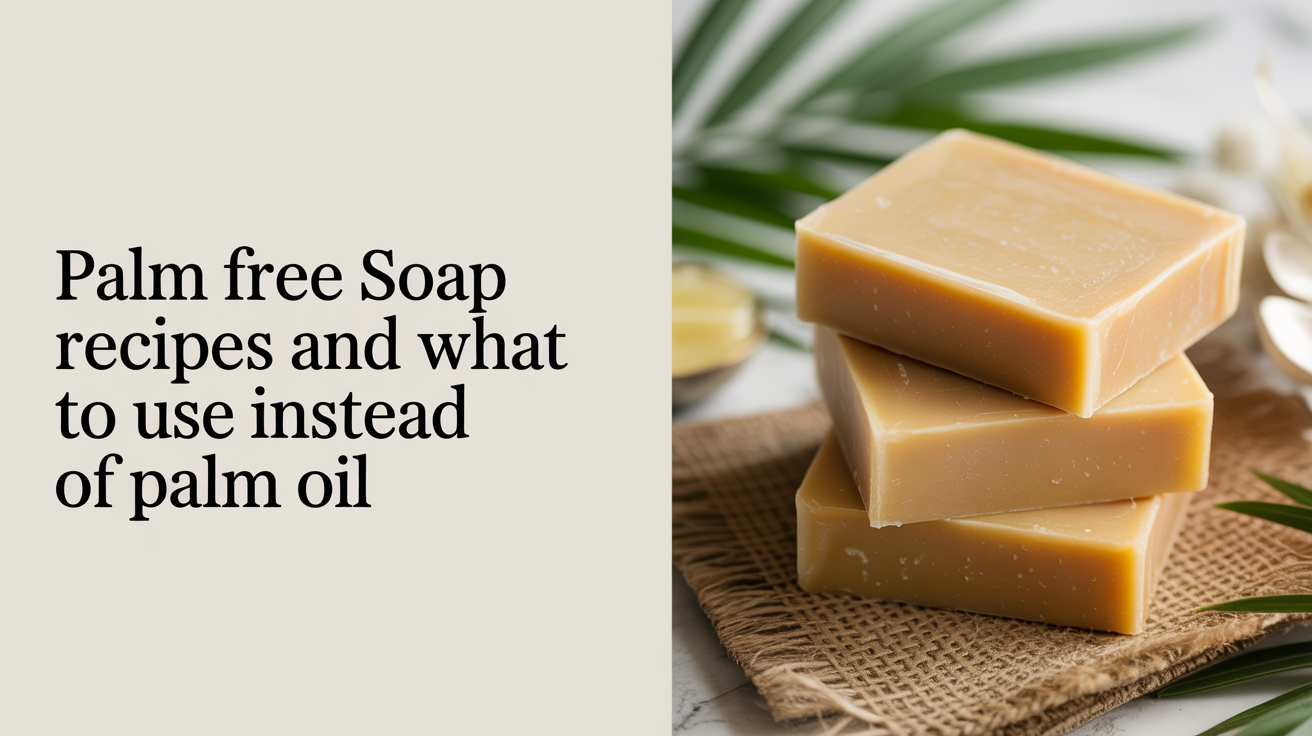
If you've started reading soap recipes, you've probably noticed palm oil shows up almost everywhere, usually in the 20 to 30 percent range alongside coconut and olive oil. A lot of new soap makers want a palm free soap recipe for sustainability reasons, then worry: will the bar still get hard, will it hold up in a wet soap dish, will the lather fall apart without it? The short answer is no, you don't need palm oil to make a good bar, but you do need to understand what it was doing so you can replace its job rather than just deleting the ingredient and hoping.
This guide covers why palm oil earned its spot in so many formulas, what the sustainability concern actually is, and which substitutes recreate the hardness and lather people rely on it for: animal fat options for makers comfortable with them, fully plant-based combinations for those who aren't, and the RSPO-certified middle path for anyone who wants to keep palm oil sourced more responsibly.
Why Palm Oil Became a Soap Recipe Staple
Palm oil is popular for a few practical reasons, not because it's magic. It's a solid-at-room-temperature fat that's roughly half saturated fatty acids, mostly palmitic acid, which gives cured bars their firmness. A bar heavy on liquid oils and light on hard fats turns soft and mushy fast, dissolving into goo after a few showers. Palm oil, along with coconut oil, is one of the two workhorse hard oils that keeps a bar solid enough for daily use.
It also contributes a stable, moderate lather, nowhere near the big bubbly foam of coconut oil, but enough to round out a recipe. On top of that, palm oil has historically been cheap and easy to source in bulk, which is a big part of why so many recipes leaned on it.
None of that makes it irreplaceable. It just means any substitute has to cover two jobs at once: hardness and lather stability.
The Sustainability Concern, In Plain Terms
The reason so many soap makers go looking for a palm free soap recipe in the first place is land use. Palm oil is grown on plantations concentrated in parts of Southeast Asia, and rapid expansion of those plantations has been linked to deforestation and habitat loss for species like orangutans, tigers, and elephants, along with the loss of peatland ecosystems that store carbon. This isn't a fringe concern. Conservation groups including the World Wildlife Fund and the Rainforest Action Network have written extensively about it, and their material is worth reading directly for the full picture.
That said, palm oil isn't uniquely bad among commodity crops. It's also one of the highest-yielding oil crops per acre, so swapping it for a lower-yield alternative can shift land pressure elsewhere rather than remove it. That's exactly why RSPO certification exists (more on that below). The point here isn't that palm oil is unusable, it's explaining why so many makers would rather not have it in their kitchen at all.
What You're Actually Replacing in the Recipe
Before swapping anything, think in terms of function rather than ingredient. In a typical beginner formula, like the one covered in our guide to the coconut, olive, and palm beginner trio, palm oil handles "hard, moderate lather" while coconut handles "hard, big lather" and olive handles "conditioning, low lather." Pull palm out and you need something for that same hard-oil role, without leaning so hard on coconut oil that it dries out skin even at a reasonable superfat.
For a broader rundown of what different oils bring to a bar, including hardness numbers and cleansing/conditioning values, it's worth reading through the best oils for soap making and what each one does before you start swapping ingredients on paper.
Option One: Animal Fats, If You're Comfortable Using Them
If you're not opposed to using animal fats, tallow (rendered beef fat) or lard (rendered pork fat) are the most direct replacements for palm oil's role. Both are solid, saturated fats that produce a hard, long-lasting bar with a gentle, creamy lather. Tallow soap actually predates palm oil soap by centuries, it was the default hard fat in home soap making long before palm oil was widely available.
A simple starting point: substitute tallow or lard for palm oil at close to a 1:1 ratio by weight, then re-run the recipe through a calculator, since tallow and lard have slightly different saponification values than palm oil and the lye amount will shift even at the same percentage. Bars made this way tend to be a touch harder and less bubbly than a palm-based version, so many makers nudge coconut oil up a few percent to rebalance the lather.
The tradeoff is obvious: some makers avoid animal fats entirely for dietary, religious, or personal reasons, and that's a completely valid reason to skip this option and go fully plant-based instead.
Option Two: A Fully Plant-Based, Vegan Combination
If animal fats are off the table, the standard vegan workaround is combining a butter with a dedicated hardening additive, because no single common vegan oil replicates palm oil's hardness and lather contribution on its own.
Cocoa butter or shea butter contribute richness, a firmer bar, and some skin-conditioning quality, but not much lather on their own. To cover the lather side, many vegan formulators add a small percentage of babassu oil, which behaves like coconut oil (similar fatty acids, similar big bubbly lather) but is often wild-harvested rather than plantation-grown. Others reach for a touch of vegetable-derived stearic acid, added at 1 to 3 percent of oils, to firm up an otherwise soft bar.
A reasonable starting point for a vegan swap: replace palm oil's percentage with roughly two-thirds cocoa or shea butter and one-third babassu oil, then adjust from there once you've made a test batch and felt how the bar cures.
Two Recipe Directions Compared
Here's how a simple beginner base looks with palm oil, then rebuilt each of the two ways described above. These are starting ratios, not fixed formulas, and every version still needs to go through a lye calculator before you mix anything.
| Oil role | Original (with palm) | Animal fat version | Vegan version |
|---|---|---|---|
| Big lather, cleansing | Coconut oil, 25% | Coconut oil, 25-28% | Coconut oil, 25% |
| Hardness, moderate lather | Palm oil, 25% | Tallow or lard, 25% | Cocoa/shea butter, 17% + babassu, 8% |
| Conditioning, low lather | Olive oil, 50% | Olive oil, 47-50% | Olive oil, 50% |
Notice the olive oil percentage barely moves. It's the hard-oil slot that changes shape, not the whole recipe.
Why You Must Re-Run a Swapped Recipe Through a Lye Calculator
This is the step new soap makers skip and shouldn't. Every oil has its own saponification value, the amount of lye needed to turn that exact oil into soap, and palm oil, tallow, lard, cocoa butter, shea butter, and babassu oil all differ. Keeping the old lye amount just because the oil weights look similar is how you end up with a batch that's either too harsh (not enough superfat) or too soft and greasy (way over-superfatted).
Any time you change even one oil, run the full oil list back through how to use a lye calculator for soap and confirm your superfat percentage before mixing anything. Also changing your batch size for a different mold? Pair that with how to adapt and resize a soap recipe so the oil-to-lye-to-water ratios stay locked as the total weight changes.
The Middle Option: RSPO-Certified Sustainable Palm
If you like how palm oil performs and don't want to give it up, RSPO (Roundtable on Sustainable Palm Oil) certification is worth knowing about. RSPO-certified palm oil comes from growers who've agreed to environmental and labor standards meant to reduce deforestation, verified through third-party audits. It isn't a perfect fix, enforcement varies across certification schemes, but for a maker who trusts palm oil's performance, it's a legitimate middle ground between using regular palm and cutting it out entirely. Look for suppliers labeling palm oil as RSPO Mass Balance or Segregated, and don't assume "sustainable" on a label means RSPO without checking.
Frequently Asked Questions
Will a palm free soap recipe lather as much as one with palm oil?
It can, but the lather has to come from somewhere else in the recipe, usually a bit more coconut oil or babassu oil. Palm oil's own lather contribution is modest, so you're mostly replacing its hardness, and lather is easier to dial in than you'd expect once you know which oil is doing that job.
Is tallow or lard actually more sustainable than palm oil?
Not automatically. Animal fats carry their own land and resource footprint, and most makers choose tallow or lard for texture and tradition, not as an environmental upgrade over palm oil. If sustainability is the main goal, RSPO-certified palm or a vegan babassu-based recipe are the more direct routes.
Can I just leave palm oil out without adding a substitute?
You can, but the bar will usually come out softer and slower to harden in the mold, and it may feel greasy longer during cure. It's not dangerous, just not ideal. If you're testing this, expect a longer cure time and consider a lower superfat to compensate.
Does babassu oil behave exactly like coconut oil in soap?
Very closely, which is why it's the go-to coconut oil substitute in vegan hard-oil blends. It shares a similar fatty acid profile and produces a similarly big, fluffy lather, though some makers find it slightly less drying at the same usage rate. It's usually priced higher than coconut oil, which is why it stays a substitute rather than a default.
How much should I trust palm oil substitute percentages I find online?
Treat any percentage, including the ones in this guide, as a starting point for a test batch, not a locked formula. Oil sourcing varies, your mold and curing conditions vary, and the only way to know a swapped recipe works for you is to run it through a calculator, make a small batch, and let it cure fully before judging it.