Getting Started
10 Beginner Soap Making Mistakes (and How to Avoid Them)
New to soap making? Here are 10 common beginner mistakes, from skipping the lye calculator to cutting bars too soon, and how to sidestep each one.
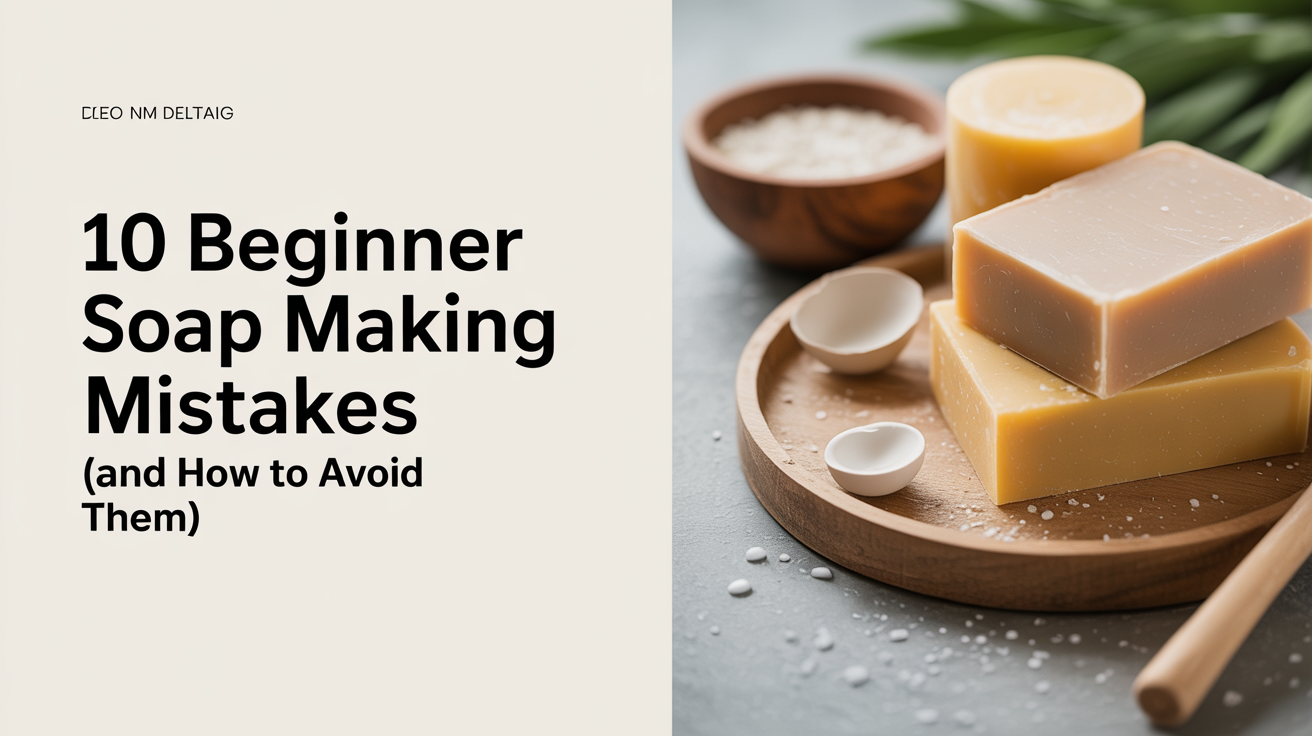
Most first batches teach you more than a tutorial ever could. But some lessons come with ruined soap, and a few come with genuine safety hazards. Knowing where beginners tend to go wrong before you start can save you from the most frustrating (and dangerous) stumbles along the way.
These ten mistakes show up again and again in beginner soap making. Some produce bars that are soft, crumbly, or won't lather. Others, particularly the ones around lye handling, can cause burns or worse. Working through this list before your first batch gives you a much better chance of walking away with something you're proud of.
Lye Handling Errors That Can Hurt You
Mistake 1: Skipping or rushing lye safety gear.
Sodium hydroxide is strongly caustic. It can cause severe chemical burns on contact with skin and eyes, and it releases heat and fumes when it dissolves in water. Goggles (not just safety glasses, actual splash-proof goggles), long rubber gloves, and long sleeves are not optional. Work near an open window or a vent fan. Keep children and pets out of the room. If lye contacts your skin, flush immediately with cool running water for 15 to 20 minutes and call Poison Control if the area blisters or does not calm down quickly. No batch of soap is worth skipping this step.
Mistake 2: Adding water to lye instead of lye to water.
The rule is lye into water, always. When you add lye to water, the reaction is vigorous but controlled. When you add water to dry lye, you can get a sudden eruption of caustic solution that splatters outward. Use a heat-safe pitcher, pour your measured water in first, then slowly pour the lye crystals into the water while stirring steadily. The solution will get very hot (180 to 200 F / 82 to 93 C is normal). Set it somewhere safe to cool before you use it.
Mistake 3: Skipping the lye calculator.
Every oil requires a different amount of lye to saponify completely. If you guess or scale a recipe by hand without recalculating, you risk a lye-heavy bar, which will be caustic and unsafe to use. Always run your recipe through a reputable lye calculator (SoapCalc and Brambleberry's calculator are two widely used options) before you start. Input every oil by weight, set your superfat (5 to 8 percent is a common beginner range), and let the calculator give you the exact lye and water amounts. See how to make soap at home, a complete beginner's guide for a walkthrough of how this fits into the full process.
Recipe and Measurement Problems
Mistake 4: Measuring by volume instead of weight.
Soap recipes work by weight, not by cups or tablespoons. Oils have different densities, so a cup of coconut oil and a cup of olive oil weigh different amounts, and the lye amount is calculated based on the weight of each oil individually. A kitchen scale that reads in grams or ounces is a necessity for soap making, not an upgrade. Measure everything, including your lye and water, on the scale.
Mistake 5: Using a recipe you found without verifying it.
Not every recipe you find online has been tested or calculated correctly. Before you make any cold-process recipe you did not create yourself, run the oil amounts through a lye calculator to confirm the lye quantity matches. If the numbers disagree significantly, trust the calculator and adjust. This takes two minutes and protects you from lye-heavy bars.
Mistake 6: Choosing an all-coconut-oil recipe for your first batch.
Coconut oil makes a hard bar with a big lather, which sounds like a win. But at high percentages (above 30 to 40 percent of the total oil weight), coconut oil produces a bar that can be drying or even stripping on skin, especially for anyone with dry or sensitive skin. A balanced beginner recipe typically combines coconut oil for lather and hardness with a softer oil like olive or canola for conditioning. See the different methods of making soap explained for context on how recipe choices connect to the method you use.
Temperature and Trace Mistakes
Mistake 7: Working with oils and lye water that are too hot.
Cold-process soap is ideally mixed when both your melted oils and your cooled lye water are in a similar temperature range, roughly 90 to 110 F (32 to 43 C) for most recipes. Mixing at very high temperatures, say above 130 F (54 C), can cause the batch to heat up rapidly in the mold (called a gel phase gone too far), accelerate fragrance and color reactions, and sometimes cause ricing or separation. Use an instant-read thermometer on both before you combine them.
Mistake 8: Not understanding trace, and then over-mixing.
Trace is the point at which your soap batter has emulsified enough to hold a drizzle on its surface without sinking back in. Light trace is ideal for swirls and complex designs. Medium trace works for most pours. If you stick-blend past medium trace before you add fragrance or color, you may not have enough time to work before the batter seizes up in the bowl. Pulse the stick blender in short bursts and alternate with stirring by hand. Stop as soon as you reach the trace you need.
Fragrance and Colorant Missteps
Mistake 9: Using fragrance oils or essential oils at the wrong amount.
More scent does not mean a stronger-smelling bar. Too much fragrance oil can cause ricing (where the batter separates into clumps), acceleration to a thick, unworkable trace, or even a batch that completely seizes. Most fragrance oils are used at 1 to 3 percent of the total oil weight. Check the supplier's recommended usage rate for each specific oil, since some accelerate trace more than others. Essential oils vary widely: citrus oils tend to fade, while patchouli, cedarwood, and clove tend to hold. See soap making supplies every beginner needs for notes on sourcing fragrance materials.
Curing and Testing Too Soon
Mistake 10: Using or gifting bars before they have cured.
Fresh-poured soap contains unreacted lye while saponification finishes, and water needs time to evaporate for the bar to harden fully. Most cold-process recipes need at least 4 to 6 weeks of curing in a ventilated spot, away from direct sunlight, before use. Cutting bars too early is a common mistake: wait at least 24 to 48 hours before unmolding (longer in cool rooms), and do not use a bar until it has cured. Before gifting or using any homemade cold-process soap, do a zap test (touch the corner briefly to the tip of your tongue) or check the pH. A tingly or zappy sensation means the bar needs more cure time.
Frequently Asked Questions
What is the single most common beginner soap making mistake?
Skipping the lye calculator is probably the most consequential mistake because it affects safety. Using incorrect lye amounts can leave a bar caustic, and you won't know from looking at it. Running every recipe through a calculator before you start takes very little time and removes a real risk.
Why did my soap turn out soft and sticky after unmolding?
Soft, sticky bars usually mean too much water, oils that were not fully melted and mixed before trace, or unmolding too soon. Let the bars cure in a well-ventilated area for several weeks. If they are still soft after 6 weeks, the recipe itself may have too high a percentage of soft oils with no hard oils to balance them.
Can I fix a mistake mid-batch?
Sometimes. If your batter looks separated or greasy before you pour, stick-blend it back to emulsion and pour it into the mold anyway. Many batches that look ugly in the bowl turn into usable soap after cure. If the problem was a calculation error, you cannot add or remove lye after the fact. Rebatching (hot-process cooking the failed batch) can sometimes rescue a batch that did not fully saponify, but a genuinely lye-heavy bar should be discarded.
My soap has white powder on the surface. Is it ruined?
That white powder is almost always soda ash, a harmless surface layer that forms when the top of the batter is exposed to air during trace. It does not affect the quality of the soap and usually scrapes off or dissolves in the first wash. To prevent it, cover the tops of poured bars with a sheet of cardboard or plastic wrap pressed against the surface.
How do I know if my soap is safe to use?
The zap test is the classic method: touch the corner of a fully cured bar to the tip of your tongue for a fraction of a second. If you feel a sharp tingle or "zap," the bar has excess lye and needs more cure time or should be discarded. If it feels like regular soap, it is ready. You can also use pH strips: finished soap typically reads between 8 and 10. Anything above 11 warrants more cure time.