Melt & Pour
Easy Melt and Pour Soap Projects to Try First
Discover the best melt and pour soap ideas for beginners, from simple layered bars to swirled designs, with tips on bases, fragrance, and color.
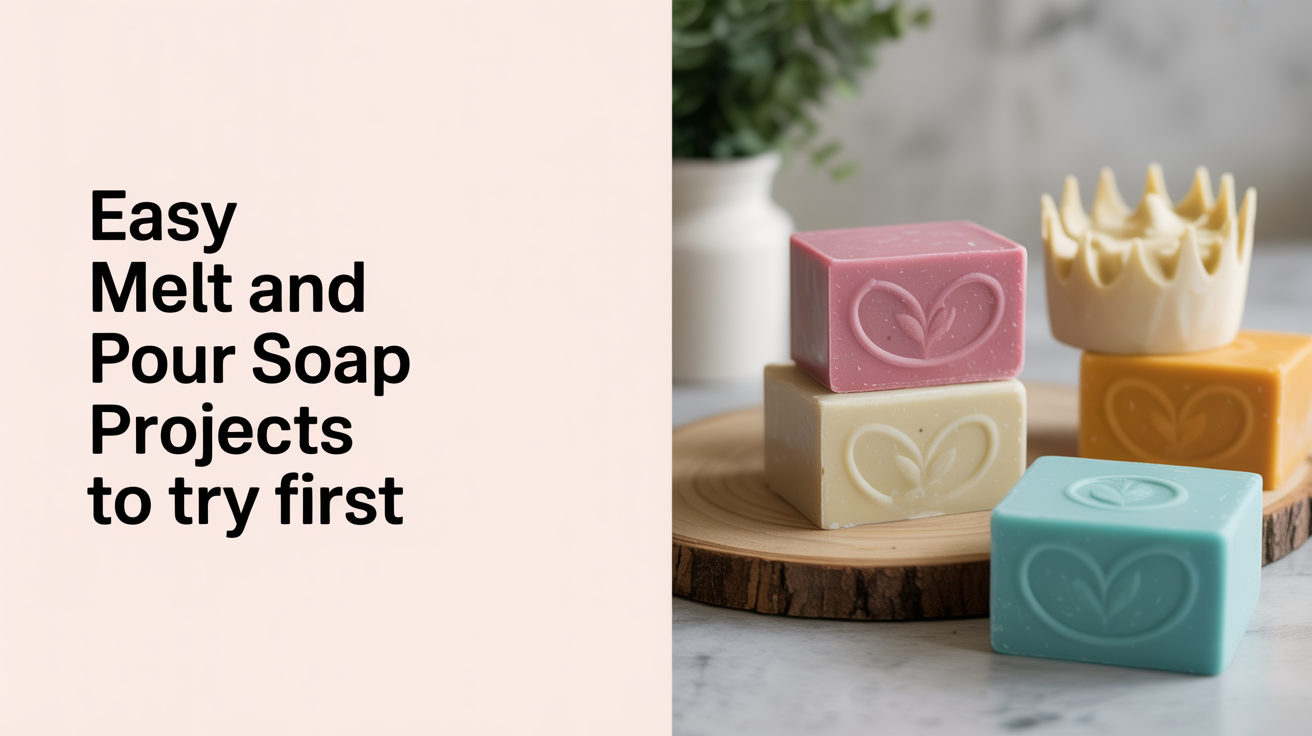
Melt and pour is the friendliest entry point into soap making. The saponification process has already happened inside the base, so there is no lye handling required on your end. You simply melt, customize, pour, and unmold. That said, when you eventually move to cold-process soap, lye becomes part of the work, and it demands full attention: always add lye to water (never the other way around), wear goggles and chemical-resistant gloves, work in a ventilated space, and run every recipe through a lye calculator before you start. For now, melt and pour lets you practice the craft fundamentals without that step.
Once you have a good base in hand and have read through a basic step-by-step process, the next question is what to actually make. Below are five approachable melt and pour soap projects, arranged roughly by complexity, so you can build skills as you go.
Single-Color Scented Bars
This is the cleanest starting point for any beginner soap project. There are no layers, no swirls, and no timing pressure. You melt the base, add fragrance and a bit of color, pour into a mold, and wait.
What you need:
- Melt and pour soap base (clear glycerin or white shea, around 8 oz / 227 g per standard 4-cavity loaf)
- Fragrance or essential oil at 1% to 3% of base weight by weight (not volume)
- Soap-safe colorant, a small amount
- Silicone mold
Steps:
- Cut the base into small cubes so it melts evenly. Microwave in 30-second bursts, stirring between each, or use a double boiler over low heat.
- Once fully melted, let it cool slightly to around 130 to 140 F (54 to 60 C) before adding fragrance. Pouring fragrance into very hot soap accelerates evaporation.
- Add colorant a drop or small pinch at a time, stirring after each addition until you reach the shade you want.
- Pour slowly into the mold to avoid bubbles. If bubbles form on the surface, a quick spritz of 91% isopropyl alcohol pops them within seconds.
- Let the soap sit undisturbed at room temperature for 1 to 2 hours. Unmold when firm.
These bars are ready to use right away since the base is already cured. Wrap them in plastic wrap or shrink wrap quickly to prevent moisture from collecting on the surface (called glycerin dew).
Layered Bars With Contrasting Colors
Once you are comfortable with the basic pour, layered bars are a natural next step. The key is patience between layers. If you pour the second layer while the first is still liquid, the colors blend together.
Process:
- Make your first batch with one color and fragrance, pour it into the mold, and spritz the surface with isopropyl alcohol to prevent a skin from forming.
- Wait until the first layer is firm but not fully set, roughly 20 to 30 minutes. You should be able to touch it lightly without leaving a fingerprint.
- Melt your second batch. Let it cool to around 120 F (49 C), which is cooler than your normal pour temperature. Pouring too hot will melt through the layer below.
- Spritz the first layer with isopropyl alcohol immediately before pouring the second layer. This helps the layers bond so they do not separate when you cut the bar.
- Pour gently, aiming for the side of the mold or a spoon held against the surface so the stream does not punch through the layer below.
Two-layer bars work especially well in contrasting colors: a white goat milk layer on top of a tinted clear layer makes for a clean, classic look.
Embedded Soap Bars
Embeds are small soap shapes suspended inside a larger bar. They are one of the more visually striking melt and pour soap ideas and require almost no advanced skill, just some planning.
You can buy pre-made soap embeds, or make your own by pouring tinted or clear soap into small silicone molds and letting them fully cure before use. Star shapes, floral shapes, or small sphere molds all work well.
Steps:
- Make your embed pieces ahead of time and let them cure completely (at least a few hours, ideally overnight).
- Melt your main base batch and let it cool to around 120 to 125 F (49 to 52 C).
- Place your embed pieces in the mold first, arranged however you like.
- Pour the base slowly around and over the embeds. Pouring too hot can melt the embed shapes.
- Spritz the surface with isopropyl alcohol, then let the soap set undisturbed.
Because the embeds are already cured soap, they generally bond well to the surrounding base as long as your pour temperature is in the right range.
Simple Swirled Soap
Swirls sound advanced but the technique is forgiving with melt and pour. You are not racing against trace or chemical reactions, so you have time to work.
What to do:
- Divide your melted base into two or three containers. Keep them warm; you will need them all to stay pourable.
- Color each portion a different shade. Work with colors from the same palette for a cohesive look (for example: ivory, pale blush, and deep rose).
- Pour one color into the mold to cover the bottom.
- Immediately pour a thin stream of the second color in a zigzag across the surface.
- Pull a skewer or chopstick through the soap in the perpendicular direction to create a swirl. Do not over-mix or you lose the definition.
- If using a third color, pour it in small dots or thin lines and swirl again.
For more ideas on working color into your melt and pour projects, it helps to understand which colorants disperse cleanly versus which ones stay chunky or bleed.
Botanical and Add-In Bars
Once you have the basics, experimenting with botanicals, exfoliants, and skin-feel additives opens up a lot of easy soap making ideas that feel more personal.
Common add-ins that work well in melt and pour:
- Finely ground oats: Mix in at about 1 tablespoon per pound of base. Provides mild exfoliation without being scratchy.
- Honey: Adds a touch of humectancy. Use about 1 teaspoon per pound. Stir in after the base cools slightly.
- Dried lavender buds or rose petals: Used as a surface decoration. Press them into the top of the soap right after pouring while the surface is still liquid. Note that botanicals embedded inside the bar can turn brown over time due to moisture trapped in the base.
- Colloidal oatmeal: Disperses more evenly than ground oats and gives the bar a creamy, soft texture.
- Kaolin clay: Adds a slight silkiness to the lather. Use about 1 teaspoon per pound of base, dispersed in a small amount of melted base before stirring into the main batch.
Keep add-in quantities modest. Too much of any additive can affect how well the bar holds together or how it lathers.
Frequently Asked Questions
Can I use any fragrance oil in melt and pour soap?
Most fragrance oils work in melt and pour without issues. The exception is fragrances with very high vanillin content, which can turn clear bases brown over time. This is cosmetic, not a problem with performance. Some fragrance oils can also accelerate setting in cold-process soap, but in melt and pour that is not a concern since you are simply pouring into a mold before it sets. Always use fragrance rated as skin-safe and stay at the manufacturer's recommended usage rate, typically 1% to 3% of the total weight of the base.
How long does melt and pour soap last before it goes bad?
An unwrapped bar can collect glycerin dew (beads of moisture on the surface) within hours in humid conditions. Wrapping bars tightly in plastic wrap or shrink wrap right after unmolding prevents this. Most commercial melt and pour bases have a shelf life of one to two years when stored unwrapped, and finished bars wrapped and stored in a cool, dry place stay good for a similar period. The main thing that shortens shelf life is the scent fading, which typically takes six to twelve months.
Do I need to cure melt and pour soap?
No. Because saponification happened during manufacturing, the base is already fully cured. Bars are ready to use as soon as they are firm enough to unmold and hold their shape, usually within one to two hours. This is one of the biggest practical differences between melt and pour and cold-process soap, which needs at least four to six weeks of curing time before it is safe to use.
Why did my melt and pour bar get white spots or a rough surface?
White spots inside a bar are usually air bubbles trapped during pouring. Pouring slowly and spritzing the surface with isopropyl alcohol reduces this. A rough or uneven top surface often means the soap started to set before the pour was complete, which happens when the base cools too much before you pour. Keep it warm, pour when the temperature is around 130 to 140 F (54 to 60 C), and work in a reasonably warm room.
Can I melt already-finished melt and pour soap and reuse it?
Yes, you can re-melt most melt and pour soap and start over if you are not happy with the result. The base tolerates multiple melt cycles without significant loss of quality. Some fragrance may volatilize with each heating, so the scent may be lighter on the second pour. Colorants generally stay stable. Avoid overheating the base on any pass, since prolonged high heat can degrade the glycerin and dull the clarity of a clear base.